
“Yaar, I checked this mutual fund. It gave 15% return in 5 years. Sounds amazing, right?”
said Neha while stirring her coffee.
Riya smiled and replied, “That is good, but did you know returns can look different depending on when you invest?”
Neha looked confused. “What do you mean? Return is return, no?”
Riya laughed softly. “That is what I thought too. Then I learned about point-to-point returns and rolling returns.”
Neha leaned forward. “Okay, now you have my attention. Tell me more.”
And this is exactly where most of us begin.
When we start investing, we often look at one number.
“This fund gave 12% in 3 years” or “This fund doubled money in 10 years.”
It feels simple and comforting.
But the truth is, returns are not always that simple.
Two women can invest in the same fund, for the same number of years, and still get different results. The reason is timing.
This is where understanding point-to-point returns and rolling returns becomes very important. Especially if you are a beginner and want to invest with confidence, not confusion.
Let us break it down in the easiest way possible.
What are Point-to-Point Returns?
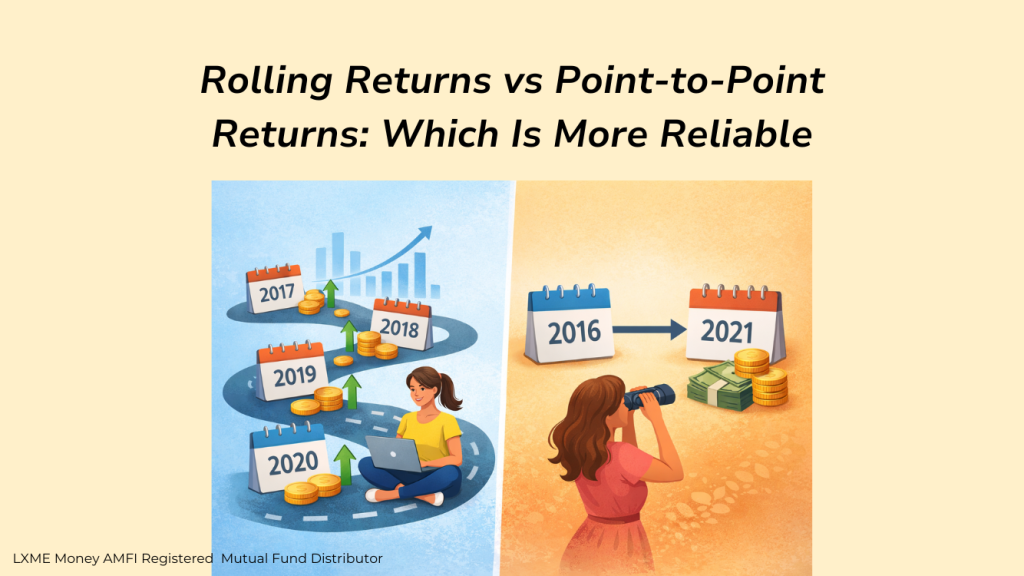
Point-to-point returns show returns between two fixed dates.
Example:
You invested in a mutual fund on 1 January 2018 and checked the return on 1 January 2025.
The return you see is the point-to-point return.
It answers one simple question:
“If I invested on this exact date and exited on that exact date, how much did I earn?”
Why point-to-point returns look attractive
- Easy to understand
- One clear number
- Often used in ads and fund comparisons
The problem with point-to-point returns
They depend heavily on timing.
If the market was low when you invested and high when you exited, returns look great.
If the market was high when you invested and low when you exited, returns look poor.
So this return may show luck more than consistency.
What are Rolling Returns?
Rolling returns look at returns for many periods, not just one.
Instead of checking only one start and one end date, rolling returns check returns for every possible period.
Example:
For a 5 year rolling return, the fund checks:
• 2015 to 2020
• 2016 to 2021
• 2017 to 2022
• 2018 to 2023
And so on.
Then we see how the fund performed across all these periods.
Why rolling returns are powerful
- They show consistency
- They reduce the impact of luck
- They show how a fund behaves in good and bad markets
Rolling returns answer a better question:
“How reliable is this fund over time?”
Simple comparison
Think of it like this.
Point-to-point return is like judging a person based on one good day.
Rolling return is like judging someone based on how they behave every day.
Which feels more trustworthy?
Which one should beginners trust more?
For beginners, rolling returns are more reliable.
Here is why.
As women, many of us invest for long term goals like:
• Children’s education
• Buying a home
• Retirement
• Financial independence
We are not investing for one lucky moment.
We are investing for stability and peace of mind.
Rolling returns help you see if a fund can stay steady over time, not just shine once.
Point-to-point returns can still be useful, but they should never be the only thing you look at.
A gentle tip for women investors
Do not feel pressured to understand everything at once.
You do not need to calculate rolling returns yourself. Many platforms already show them.
Just remember this simple rule:
If a fund looks good only in one period, be careful.
If a fund looks good across many periods, it is more dependable.
You deserve investments that support your dreams quietly and consistently.
Conclusion
Point-to-point returns show a snapshot.
Rolling returns show the full story.
As a beginner woman investor, always try to look beyond one shiny number. Ask questions. Take your time. Learn step by step.
Like Neha, curiosity is your first step.
Like Riya, knowledge becomes your strength.
And with the right understanding, your money can grow along with your confidence.
If you want, I can also
• simplify this further into an Instagram carousel
• add real life examples with numbers
• rewrite it in a more fun or more emotional tone
Just tell me what you need next.
FAQs
When should investors look at point-to-point returns?
An investor would use point to point returns to determine their desired focus of analyzing how an investment has fared between two particular dates. This would be applicable when you made an investment on a certain day to determine your actual return or when trying to determine how your actual investment grew alongside the historic performance of a fund. However, this tool should not be solely relied upon to determine its usefulness or effectiveness as a fund.
Should investors consider both rolling and point-to-point returns?
Investors should, take into account both rolling returns and point-to-point returns.
Point-to-point returns aid in judging the performance of an investment between two specific points in time. It can also aid in determining how consistent an investment has been over time using the rolling returns method. Both methods combined will provide a better perspective of the investment, especially for new investors seeking to invest with conviction.
Further Read:
How AI Is Transforming Portfolio Risk Management
Understanding UPI Transaction Limits and How to Manage Them
How to Transfer Your Home Loan to Another Bank and Save Money