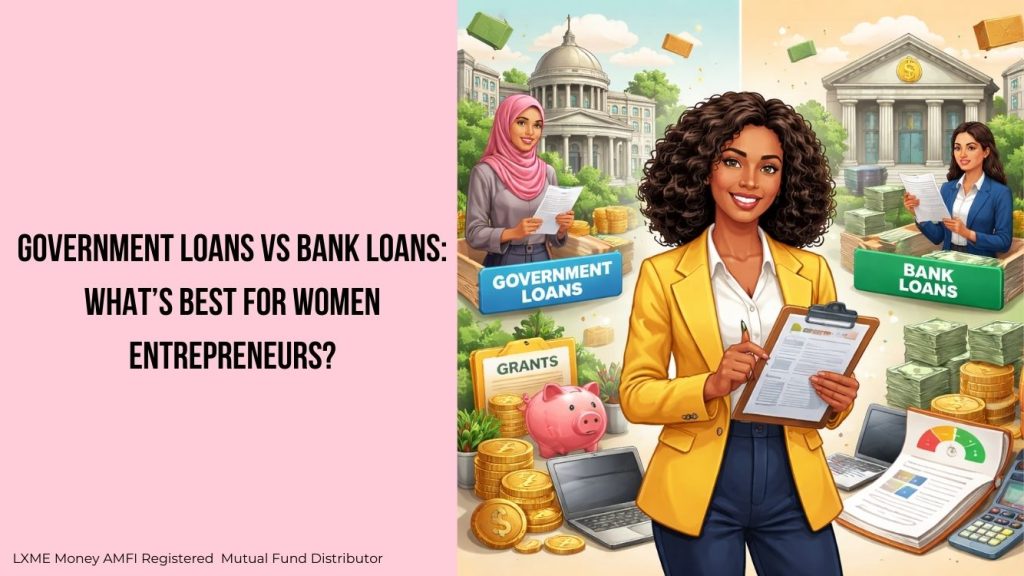
India is witnessing a powerful shift; more women are stepping into entrepreneurship than ever before. From homegrown brands and digital startups to manufacturing units and service enterprises, women are building businesses across sectors. However, one challenge remains constant: access to the right funding.
Government Loans for Women Entrepreneurs
Government schemes are specially designed to encourage women-led businesses. They usually offer lower interest rates, easier eligibility, and minimal collateral requirements. Government loans are financial schemes introduced to promote entrepreneurship, especially among women and small business owners. These schemes are designed to make funding more accessible and affordable. Some well-known schemes include:
- Pradhan Mantri Mudra Yojana: Provides collateral-free business loans up to ₹10 lakh under three categories: Shishu (up to ₹50,000), Kishor (₹50,000–₹5 lakh), and Tarun (₹5–10 lakh). Interest rates are decided by banks (generally competitive for MSMEs), repayment tenure usually ranges from 3–5 years, and no collateral is required for eligible borrowers.
- SHE Mart: An initiative that provides women entrepreneurs, especially self-help groups, a platform to sell and promote their products. It focuses on market access and business visibility.
Advantages:
- Affordable interest rates
- Reduced or no collateral requirement
- Focused support for women entrepreneurs
- Suitable for small-scale or home-based businesses
Limitations:
- Lengthy documentation process
- Slower approval timelines
- Loan amount may be limited
Best Suited For:
Women who are starting small businesses, working from home, or entering entrepreneurship for the first time.
Understanding Bank Loans
Bank loans are offered by public and private sector banks as well as NBFCs. These loans are more commercially structured and often suited for businesses seeking expansion. Bank loans generally provide higher loan amounts and structured repayment plans. Approval depends heavily on your credit score, income proof, and business performance.
Advantages:
- Higher funding limits
- Faster processing (in many cases)
- Flexible tenure options
- Suitable for business expansion
Limitations:
- Higher interest rates compared to government schemes
- Collateral may be required
- Strict eligibility and credit score checks
Best Suited For: Women entrepreneurs who already have an established business and need significant capital for scaling operations.
3. Comparative Overview
| Factor | Government Loan | Bank Loan |
| Interest Rate | Generally lower | Moderate to high |
| Collateral | Often not required | Usually required |
| Processing Time | Slower | Faster |
| Loan Amount | Limited (small business focus) | Higher funding available |
| Eligibility | Relaxed criteria | Strict credit-based approval |
4. How to Decide?
Your choice should depend on three main factors:
- Stage of Business—Startup or Expansion?
- Loan Amount Required—Small capital or large investment?
- Repayment Capacity—Can your business comfortably handle EMIs?
- Eligibility Criteria—Do you qualify for a government scheme? If you are not eligible for a government loan, then a bank loan becomes the practical option.
If you are beginning your entrepreneurial journey with limited resources, a government-backed scheme may provide safer and more affordable funding. If your business is stable and you require larger capital quickly, a bank loan may be more practical.
FAQs
Which is easier to apply for government or bank loans?
Bank loans are generally faster and easier to apply for, while government loans are easier to qualify for if you meet the eligibility criteria.
Are government loans cheaper than bank loans?
Yes, government loans are usually cheaper than bank loans because they often offer lower interest rates, subsidies, or guarantees under special schemes.
Can I avail both government and bank loans simultaneously?
You can avail both government and bank loans simultaneously if you meet the eligibility criteria, have sufficient repayment capacity, and comply with scheme restrictions and bank credit assessments.
Can bank loans be used for any business purpose?
Bank loans can generally be used for most legitimate business purposes, including working capital, expansion, equipment purchase, inventory, marketing, or infrastructure, depending on the loan type and bank terms.