
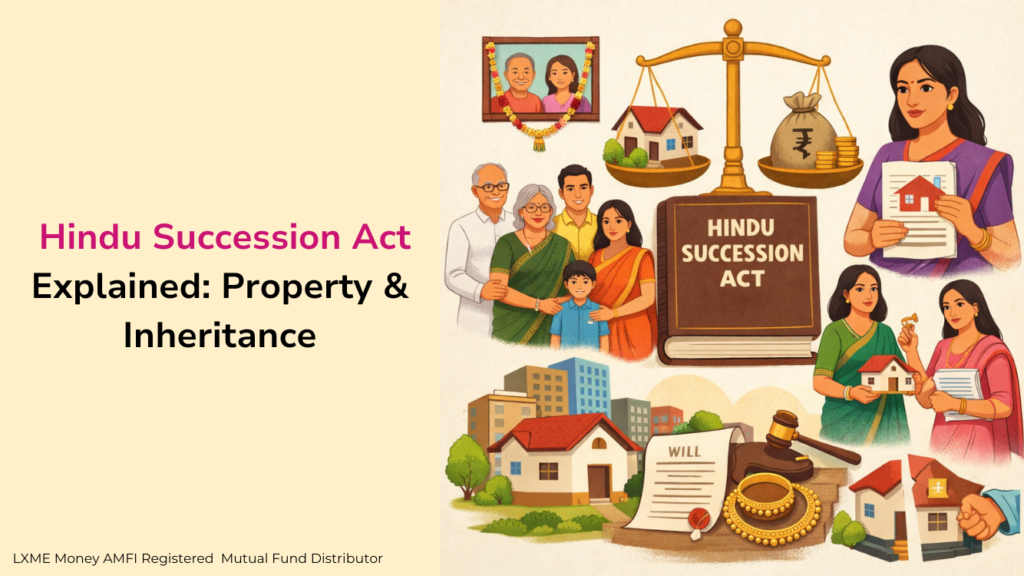
Most women grow up hearing things like:
“Property matters are handled by the elders.”
“Brothers usually have more rights.”
“Married daughters don’t really claim these things.”
If this conversation feels familiar, you’re not alone.
Because for many women, property has always been spoken about like a family matter—not a legal right.
But your legal rights may be very different from what you’ve been told.
Let’s break it down simply & clearly
What is the Hindu Succession Act?
The Hindu Succession Act 1956 is the law that governs how property is inherited when someone passes away.
In simple words, this law explains:
- who has a legal right over property?
- how property gets divided?
- what happens if there is no will?
- and where daughters, sons, wives, mothers, and other family members stand?
This hindu succession act is one of the most important parts of succession law in India because it directly affects families, property ownership, and financial security
And yes, it matters a lot for women.
Who does the Hindu Succession Act apply to?
The Hindu Succession Act 1956 applies to:
- Hindus
- Buddhists
- Jains
- Sikhs
It generally does not apply to Muslims, Christians, Parsis, or Jews, as they follow different personal laws related to inheritance and succession.
Do daughters have equal rights?
Yes, they do.
Under the Hindu Succession Act, daughters have equal rights as sons in many inheritance matters, including ancestral property under Hindu law.
For years, property conversations have often been treated like a “family matter” rather than a legal and financial rights matter. But the two are not the same.
Knowing your rights doesn’t mean creating conflict.
It means understanding where you stand.
What is a succession certificate?
Now let’s come to a term many people hear after a family member passes away: succession certificate.
A succession certificate is a legal document that may be needed to claim certain assets of a person who has passed away, especially if there is no will.
It is often used for:
- shares
- investments
- debts
- Securities
- Properties
This is where many families get confused.
Even if you are a rightful heir, institutions may still ask for legal proof before transferring assets. That’s where a court succession certificate becomes very important.
What is the succession certificate process?
The succession certificate process usually includes:
- filing an application in court
- submitting documents like the death certificate and heir details
- court verification
- issuance of the certificate if everything is clear
This process can feel overwhelming, which is why awareness is so important.
What if there is a will?
If there is a valid will (the will should be registered), then the property is generally distributed according to that will.
But even then, disputes can happen if:
- The will is unclear,
- The will is challenged,
- The property type creates separate legal questions,
- Family members claim unfair influence or invalid execution.
That’s why estate planning, nomination, and clean documentation are just as important as knowing the Hindu Succession Act.
Why this conversation matters in real life
Let’s be real—many women are told to stay quiet during property discussions to “keep peace” in the family.
But understanding the Hindu Inheritance Act is Awareness. Awareness doesn’t create conflict. It creates clarity.
It is about knowing what is legally yours.
At Lxme, we believe financial awareness is not only about earning, saving, and investing. It is also about understanding your rights—especially the ones nobody talks enough about.
Final thought
The Hindu Succession Act, 1956 is not just about property or paperwork.
It is about making sure women are not kept unaware of what is rightfully theirs.
Because every woman should know this:
Asking about your rights is not greed — it is financial awareness.
FAQ
Does the Act apply to agricultural land?
Yes, in many cases it does—but the rules can vary depending on the state and the nature of the land.
Does the Hindu Succession Act apply to NRIs?
Yes, it can apply to NRIs if the property and inheritance matter falls under Hindu personal law in India.
Further Read:
What are penal charges and when do banks apply them?