
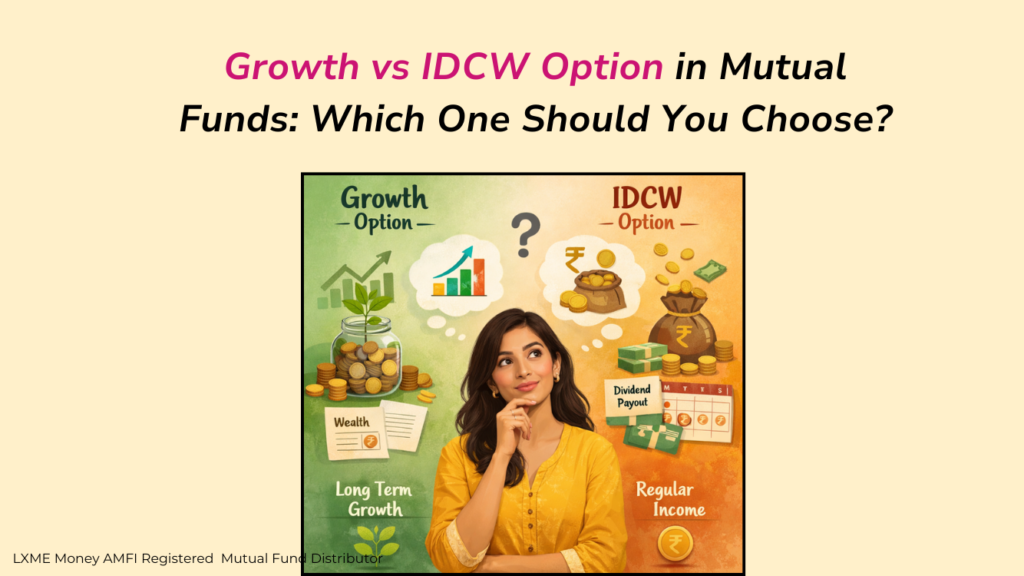
Many investors choose mutual funds carefully but overlook one small option while investing – Growth or IDCW.
Many women who are gradually taking charge of their financial decisions, whether it’s planning for their child’s education, building personal savings, or contributing to long-term family wealth, understanding this difference can make investing feel far less confusing.
Let’s break it down in a simple and practical way.
What Exactly Are Growth and IDCW Options?
Whenever you invest in a mutual fund, the fund house usually asks you to select one of two options:
- Growth Option
- IDCW Option
Both options participate in the same investment portfolio. The difference lies in what happens to the profits generated by the fund.
In one option, profits stay invested. In the other, they may be distributed to investors from time to time.
Understanding the Growth Option?
In the Growth option, any profit earned by the mutual fund is reinvested back into the scheme instead of being paid out to investors.
This means:
- Your money stays invested
- The NAV (Net Asset Value) keeps increasing
- Your investment grows through compounding
Simply put, the fund keeps building wealth inside the investment instead of distributing it to the investors.
Example:
Let’s say you invest ₹1,00,000 in a mutual fund under the Growth option.
If the fund performs well, the profits remain invested, and over the period of time your investment could grow to ₹1,80,000 or ₹2,00,000, depending on market performance.
You receive the money only when you redeem the units.
What is the IDCW Option?
IDCW stands for Income Distribution cum Capital Withdrawal.
Earlier, this option was simply called Dividend Option, but the name was changed because the payout is not always pure profit , sometimes it can include a portion of your own invested capital.
In this option:
- The fund distributes income periodically
- The payout depends on the fund’s performance and decision of the fund house
- The NAV reduces when the payout happens
Let’s understand this with an example.
Let’s assume you invested Rs 1,00,000 in a mutual fund scheme where the NAV is Rs. 5 per unit. So the number of units you receive is 20,000 units.
However, the NAV of the fund falls accordingly. you receive cash, the investment value also decreases.
Key Difference Between Growth and IDCW
| Feature | Growth Option | IDCW Option |
| Profit | Reinvested in the fund | Distributed to investors |
| NAV Movement | Continues to rise with reinvestment | Drops when payout happens |
| Cash Flow | No regular payouts | Regular income possible |
| Best For | Long-term wealth creation | Investors needing regular income |
Both options are part of the same mutual fund scheme, but the returns given to investors differ. method changes.
The Tax Impact You Should Know
Taxes play a very important role in choosing between the two options.
Taxation in Growth Option
You pay tax only when you redeem the units.
- Equity funds:
- Short-term capital gains: 20%
- Long-term capital gains: 12.5% (above ₹1.25 lakh)
- Debt funds: Taxed as per income slab (for new investments).
This allows your money to compound without yearly tax interruptions.
Taxation in IDCW Option
IDCW payouts are taxed in the investor’s hands as per their income slab.
Let’s say you are falling in a 30% tax bracket, a significant part of the payout may go towards taxes.
This makes IDCW less tax efficient for many investors, especially those who are in higher income brackets.
Why many investors prefer Growth
Growth option works well for:
- Long-term wealth creation
- Retirement planning
- Building a corpus for children’s education
- Investors who do not need regular payouts
For many working women or young professionals starting their investment journey, the Growth option helps build financial independence over time.
When Is IDCW a Suitable Choice?
Even though Growth is often recommended, IDCW can still be useful in certain situations.
For example:
- Retired investors who need regular income
- Individuals who prefer regular payouts instead of redeeming units
- Investors who rely on investments for monthly expenses
Some women who manage household finances may prefer occasional payouts to support family expenses without selling their investments.
But it’s important to remember that IDCW is not guaranteed income. The fund house decides whether to distribute it or not.
The Power of Compounding in Growth Option
One of the biggest advantages of the Growth option is compounding.
When profits remain invested, they generate further returns over time.
For example:
Investment Value : ₹2,00,000
Rate of Return : 12% annual return
After 10 years: ~₹6,21,000
After 20 years: ~₹19,29,000
This exponential growth happens only because the profits are continuously reinvested.
For investors thinking long term , especially women building their own financial security , compounding becomes a powerful wealth creator.
You can start investing with just Rs 100 with Lxme
Final Thoughts
Choosing between Growth and IDCW is not about which one is “better”. It’s about which one fits your financial goals and needs.
Growth focuses on wealth creation and compounding
While IDCW focuses on regular income
But the most important thing is understanding your investment because when you understand where your money goes, you make more confident financial decisions.
FAQ :
Is IDCW taxable in India?
Yes, IDCW is taxed at investors’ tax slab rate.
When should I choose the IDCW option?
IDCW can be suitable for investors who prefer regular payouts from their investments, such as retirees or those relying on investments for periodic income
Further Read: