
Priya: Meera, have you heard of the latest announcements by SEBI on mutual funds?
Meera: Yes! They are making it easy by removing overlaps from mutual funds.
Priya: I like the way the lifecycle of mutual funds is planned. It gradually decreases equity investments and allows a percentage of gold investments as well.
Meera: And the investment of money in multi-asset funds is according to the allocation benchmarks. Diversification at last!
Priya: Time to think about my investments from a new point of view. By the way, below is a nice blog that explains to us about SEBI new update:
SEBI MF Categorisation and Rationalisation 2026: A Complete Investor Guide
The Securities and Exchange Board of India (SEBI) has proposed significant changes in the categorisation and rationalisation of mutual funds in February 2026. These changes are aimed at simplifying the options available in mutual funds, reducing the overlaps in the schemes of the mutual funds, and helping the investors make informed decisions.
If you are an investor or a potential investor in the mutual funds in India, it is essential that you are aware of these changes, whether you are a seasoned investor or a new investor in the form of a systematic investment plan.
Why SEBI Overhauled Mutual Fund Categories
The Indian mutual fund industry has grown significantly in recent times with a variety of innovative products. However, the variety of products available in the Indian mutual fund industry has also led to a certain degree of complexity:
- Funds with “aggressive growth” potential may have very similar portfolios.
- Hybrid funds may have differing allocation levels, making diversification a complex process.
- The regulations of 2017 may have removed the problem of overlapping funds, but the new structures of the mutual funds have led to subtle overlaps.
The 2026 SEBI framework has taken care of these issues in the following manner:
- Alignment of Fund Names with Actual Portfolios.
- Launch of Life Cycle Funds with investment amounts based on the age profile of the investor.
- Standardisation of allocation levels of various Fund Categories.
- Allowance of small allocation levels of investments in Gold, ETFs, and Alternative Investments.
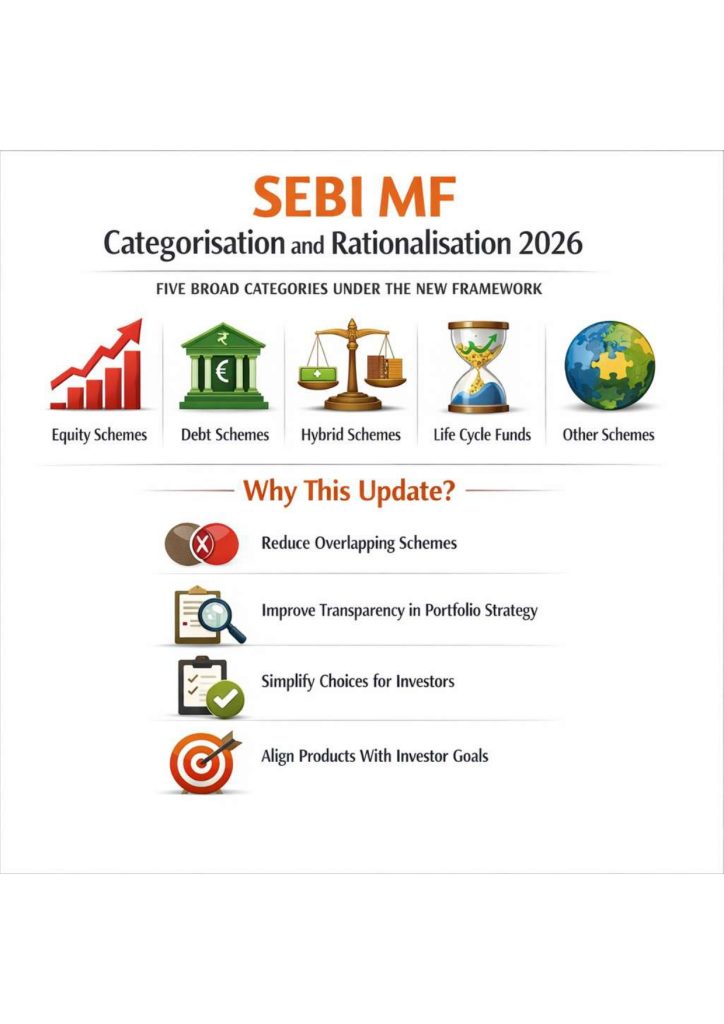
Five Broad Categories Under the New Framework
SEBI has divided mutual funds into five broad categories as follows:
- Equity Schemes – Large Cap, Mid Cap, Small Cap, Multi-Cap, Flexi-Cap.
- Debt Schemes – Liquid, Ultra-Short Duration, Corporate Bond, Gilt, Medium/Long Duration, and Sectoral Debt Funds.
- Hybrid Schemes – Aggressive, Conservative, Balanced Advantage/Dynamic, Multi-Asset Allocation
- Life Cycle Funds – Open-ended schemes with target maturity and glide path investment strategy.
- Other Schemes – Fund of Funds (FoFs), Passive Schemes, Index Funds, ETFs, Commodity,and Overseas.
Phasing Out Goal-Based Funds
Solution-oriented funds like retirement funds, education funds, etc., were essentially hybrid funds with minor modifications and lock-ins. SEBI’s major steps:
- Categorisation: These funds will be categorised based on their actual composition.
- Subscriptions: Subscriptions for solution-oriented funds have been completely barred.
- Existing investors: No need to exit, and funds will be categorised appropriately.
Life Cycle Funds: Investing That Evolves with You
The highlight of the 2026 framework is Life Cycle Funds. These funds automatically adapt to the life cycle of the investor by allocating assets according to the phase in his/her life, using a glide path:
- Early stage – Growth phase: High allocation to equities for capital growth.
- Mid-career – Balanced phase: Gradual increase in debt and gold investments.
- Near retirement – Preservation phase: High debt, low equities, and gold for risk management.
Up to 35% of the fund assets may be invested in gold, ETFs, InvITs, and debt for diversification, according to SEBI. Life Cycle Funds are also benchmarked against a Multi-Asset Allocation benchmark, thus allowing for performance comparisons with other goal-based funds.
The regulations:
- Target maturity options: 5, 10, 15, 20, 25, and 30 years.
- Maximum 6 Life Cycle Funds per AMC.
- The fund must be named with the year in which maturity is expected, for example, Life Cycle Fund 2055.
- Prior to maturity, if the investment horizon is less than 5 years, equity investments gradually decrease, and short-term equity arbitrage is allowed for up to 50%.
Exit load:
3% if redeemed in less than 1 year.
2% if redeemed in 2 years.
1% if redeemed in 3 years.
Example: Shreya’s Life Cycle Fund
Let’s consider a case where we have a 30-year-old professional who wants to start a life cycle fund for retirement planning
| Age | Equity (%) | Debt (%) | Gold (%) | Rationale |
| 30 | 80–85 | 10–15 | 0 – 5 | Growth-focused phase; long horizon, higher risk tolerance |
| 45 | 60–65 | 25–30 | 10 | Mid-career; balancing growth and stability |
| 60 | 30–35 | 55–60 | 10 | Capital preservation; minimal equity exposure |
The portfolio of Shreya changes automatically as she gets closer to retirement while ensuring that her investments are safe as well as profitable.
SEBI-Defined Allocations Across Fund Categories
Equity Funds
| Category | Equity Allocation | Rationale |
| Large Cap | 80%+ | Invests in the top 100 companies by market capitalization for stability and steady returns |
| Mid Cap | 65%+ | Focused on mid-sized companies with higher growth potential. |
| Small Cap | 65%+ | Targets smaller companies offering high growth but higher risk. |
| Multi Cap | Min 25% each in market cap | Flexible allocation across market caps to balance risk and opportunity |
| Flexi Cap | 65%+ | Manager can adjust allocation dynamically to capture opportunities across all caps |
Hybrid Funds
| Category | Equity | Debt | Rationale |
| Aggressive Hybrid | 65–80% | 20–35% | Growth-oriented, some stability |
| Conservative Hybrid | 10–25% | 75–90% | Capital preservation focus |
| Balanced Advantage / Dynamic | Flexible | Flexible | Manager discretion to balance risk |
| Multi-Asset Allocation | Min 10% in ≥3 asset classes | Flexible | Diversified multi-asset strategy |
Debt Funds
| Category | Typical Allocation / Focus |
| Liquid Funds | Short-term money market instruments; minimal credit risk |
| Ultra Short Duration | 3–6 months maturity; low interest rate sensitivity |
| Short Duration | 1–3 years maturity; slightly higher yield |
| Corporate Bond Funds | 65–100% corporate bonds; credit rating restrictions |
| Gilt Funds | 80–100% government securities; interest rate risk varies with maturity |
| Medium / Long Duration | 65–100% government/corporate bonds; higher sensitivity to rates |
With these clear allocations in place, investors can now confidently make comparisons between schemes and invest in funds that are aligned to their risk-return aspirations.
Reducing Portfolio Overlap and Sectoral/Thematic Rules
SEBI has also made its regulations stronger on portfolio distinctiveness:
- Value vs Contra Funds: These funds can hold only up to 50% in common stocks, thus keeping these funds distinct from each other.
- Sectoral/Thematic Funds: These funds have to maintain distinctness in terms of strategies, and there can be no more than 50% overlap in these funds.Phased compliance over 3 years (35% reduction in Y1 & Y2, 30% in Y3).
- FoFs: Equity FoF, Debt FoF, Hybrid FoF, Commodity FoF, Overseas FoF. They could be Active, Passive, or Active+Passive.
- Disclosure Requirement: Fund managers will be required to disclose monthly reports on the AMC websites.
This ensures prudent diversification rather than the illusion of it.
Compliance Timeline and Naming Rules
- All existing funds need to comply with the new categorisation within six months, i.e., by August 2026.
- SEBI demands standardisation of fund naming conventions that reflect the real investment strategy of the fund.
- These are not considered Fundamental Attribute Changes, hence investors do not get any right of a forced exit.
This will help investors better track their investments and understand exactly what they are investing in.
Why These Changes Matter to Investors
- Clarity: No more guessing the underlying holdings of competing funds.
- Effective Risk Distribution: Funds truly vary in their portfolios.
- Behavioral Discipline: Life Cycle Funds rebalance automatically and minimize mistakes.
- Portfolio Protection: Gold, ETFs, and diversified allocations hedge against market volatility.
- Transparency and Compliance: Clear naming and disclosure of changes and timelines monitor the portfolio.
What it means for Shreya is that her investments will grow in line with her life goals without any micromanagement.
The Bigger Picture: A Mature Mutual Fund Industry
SEBI’s 2026 rationalisation is a hallmark of a maturing mutual fund industry in India. From attracting new investors, we have now shifted our focus towards an investor-centric approach:
- Clear and standardised fund categories
- Disciplined portfolios
- Goal-oriented Life Cycle Funds
What does it mean for an investor like Shreya? Less confusion, smart investing, and our funds working with, not against, life.
Key Takeaways for Investors
- Review your existing funds to understand the reclassification.
- Consider Life Cycle Funds for long-term investment goals to avoid manual rebalancing.
- Review your investments to ensure the risk appetite matches the investment horizon.
- Invest in gold, ETFs, and other asset classes to hedge against volatility.
- Review the disclosures and timelines to be updated on fund compliance.
The SEBI categorization and rationalization of mutual funds in 2026 is a move towards simpler, smarter, and goal-oriented mutual fund investments.
Disclaimer – The information provided is for educational and informational use only. It is neither an investment advice nor a solicitation or promotion for any mutual fund product. One must consult official sources or a financial advisor for making investments.
FAQs:
Q1: What is the primary objective of SEBI’s 2026 categorisation and rationalisation of mutual funds?
The primary objective of the framework is to simplify the choices available to mutual fund investors. It helps eliminate the complexity of multiple schemes with the same investment strategies. It also helps in the actual diversification of investments across different categories of mutual funds.
Q2: What are the key changes in the new framework for the investor in terms of lifecycle and multi-asset funds?
Lifecycle funds are required to follow a glide path that reduces the equity component as the maturity date approaches. There is a provision for a small allocation to gold for the purpose of diversification. Multi-asset funds are required to adhere to the allocation guidelines.