
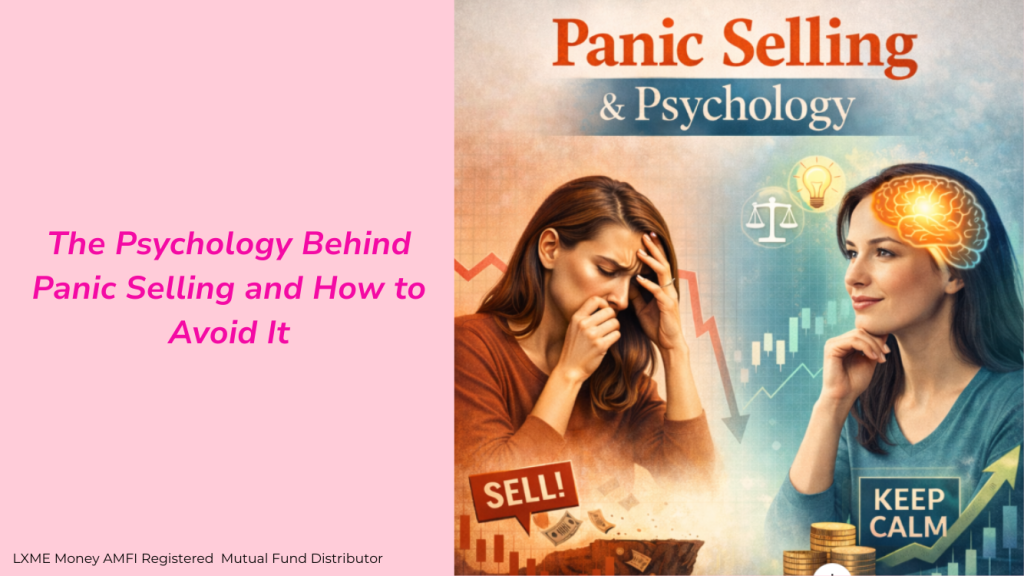
When markets tumble, fear spreads quicker than facts. Red screens, shrill headlines screaming “Bloodbath!”, WhatsApp forwards, and social media predictions create a sense of urgency “Exit now or lose everything.” This is when panic selling occurs.
In regard to panic selling in the stock market, it is not indicative of intelligence or ability. Rather, it is an instinctual reaction to emotion. To avoid panic selling altogether, knowing why panic selling occurs is crucial, as women with the right mindset can react to it effectively.
What Is Panic Selling in the Stock Market?
Panic Selling involves the actions of investors rushing to sell their investments out of fear of losses during steep declines in the markets, without even considering the fundamentals of the investments and the long-term strategies of the investors.
Ironically, panic selling is usually followed by:
- Selling at the lowest point
- Locking in losses
- Missing the Market Recovery
While markets inherently trend toward a return in value over time, money sold in times of panic is unlikely to reap such rewards.
The Psychology Behind Panic Selling
- Loss Aversion: Why Losses Feel So Painful
One of the most powerful concepts in behavioral finance is the concept of loss aversion, meaning humans feel the pain of a loss almost twice as strongly as the happiness of an equivalent gain.
So, when markets fall:
- Perpetuity of a temporary loss
- Fear is overwhelming
- The urge to “stop the pain” gets worse. All the emotional discomfort pushes them to sell, even when logic says stay invested.
- Emotional Investing vs Rational Investing
Most women invest with significant goals in mind, such as financial independence, family security, their children’s education, or a peaceful retirement. During periods of volatility, however, emotions often overpower goals.
Ideas like:
What if the market keeps falling?
I can’t afford to lose this money
Maybe I’m not meant to invest
This is emotional investing, where decisions are guided by fear instead of a strategy. Emotional investing doesn’t mean you’re wrong-it means you’re human. The solution lies in awareness, not avoidance.
- Herd Behavior: Following the Crowd
Herd behavior plays a critical role in panic selling. When investors see others selling ; friends, relatives, influencers, or institutions , they assume there must be hidden information behind the selling.
Then the line of thought becomes something like
Everybody is leaving, so must I?
What if I’m the only one left holding losses?
This is the crowd mentality that increases fear and accelerates selling when fundamentals have not changed.
- Event-Driven Volatility and Market Free Fall
During major events, the volatility of an event dramatically increases due to global crises, changes in interest rates, geopolitical tensions, and many other factors. Major participants in the market begin to readjust positions, volatility levels break through normal ranges, and fear overrides logic. All these combine in a chain reaction to evoke panic selling that sometimes leads to a short-term free fall in the markets.
These falls are usually emotion-driven, not value-driven. Markets might correct in a big way, but they also stabilize and recover once emotions cool down.
- Media Influence and Marketing Psychology
Through marketing psychology, media coverage impacts investor behavior on a very serious level. It’s the fear that gets attention, and dramatic headlines raise engagement.
Similar to psychologists’ advertising, media stories employ:
- Urgent language
- Worst-case scenarios
- Repeated negative visuals
This constant exposure increases anxiety, therefore adding pressure to act right now. Unfortunately, in investing, urgent actions are rarely wise actions.
Why Women Can Be Better at Avoiding Panic Selling
Studies reveal the following regarding women:
- Trades less often
- Take less spur-of-the-moment decision
- Emphasize long-term results
These qualities are enormous strengths. With good financial knowledge and confidence, women can perform better not by taking more risks but by remaining steadfast in the middle of turmoil.
- Anchor Investments to Life Goals
Markets fluctuate, but goals don’t. Always ask:
Has my goal changed?
Or has only the market changed?
If the goal is long-term, then there is no need for decisions to be based on short-term volatility.
- Accept Volatility as the Cost of Growth
Ups and downs in the market are not failures but part of the processes. The volatility is a price that one has to pay for long-term wealth creation. And avoiding it completely also means growth evasion.
- Reduce Portfolio Over-Monitoring
Checking the portfolio daily makes a person emotionally stressed and full of reactive decisions. Wealth builds over time, not by tracking constantly. Periodic reviews are much healthier than daily checks.
- Automate to Remove Emotions
Systematic investing, asset allocation, and rebalancing reduce emotional interference. Automation lets your money work quietly while you focus on life and goals.
- Replace Fear With Financial Understanding
Fear flourishes in ignorance. Education brings clarity. When women know how markets perform during cycles, calmness substitutes panic.
Fearless investing is the first step towards financial freedom. Avoid the panic, invest wisely, and start your equity MF journey with just ₹100 through LXME, your trusted partner throughout your financial journey to achieve your desired financial goal.
Closing Thought: Calm as a Superpower of Finance
Panic selling is not a mistake; it is a psychological reaction. However, long-term wealth is built by those who can pause, understand, and stay invested. For women, investing is not about reacting to market noise; rather, it’s about creating freedom, security, and confidence over time. The markets will rise and fall, but calm, informed decisions will always compound
FAQ
Why do investors panic sell during market crashes?
Fear, uncertainty, loss aversion, and media influence negate the use of rational thinking.
What psychological factors cause panic selling?
Aversion to losses, emotional stress, herd behavior, and the deluge of negative news.
What role does herd behavior play in panic selling?
This is an external pressure that may persuade the investor to follow the herd rather than sticking to his own plan.
How does media coverage influence panic selling?
Sensational headlines and repeated negative messages create much anxiety, besides triggering impulsive exits.
Further Read,