
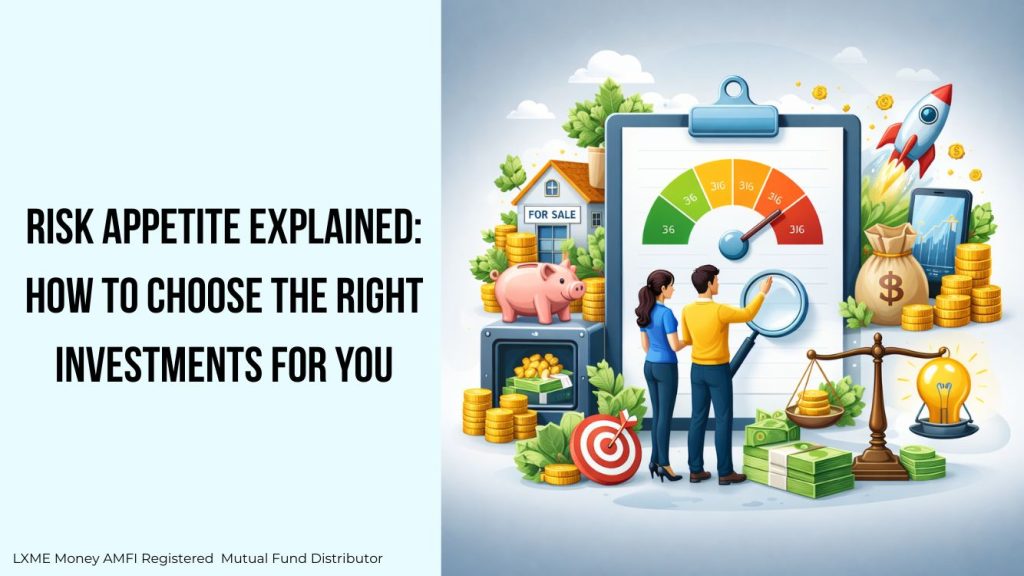
When it comes to investing, one size does not fit all. The right investment for someone else may not be right for you and that’s where risk appetite comes in.
What is the risk appetite?
To put it simply, Risk appetite means how much risk you are comfortable taking with your money while investing. It includes your ability to handle ups and downs in the market and the chance of losing money to earn better returns. Everyone’s risk appetite is different, and it should match your goals and time horizon.
Classification of investors based on their risk appetite
In the context of investment, risk appetite is often used as a way to classify investors investing in mutual funds and other securities. And here’s how investors can be categorized based on their varying risk appetite.
Conservative Risk Appetite:
A conservative investor prefers safety above everything else. The main goal is to protect the money rather than grow it quickly. Such investors feel uncomfortable when their investment value goes down, even for a short period, and market ups and downs cause stress. They usually choose stable options like fixed deposits, government schemes, or debt mutual funds, which aim to provide more stable and lower-volatility returns compared to equity investments. Since mutual funds are subject to market risks, returns are not guaranteed. Conservative investors are often those nearing their financial goals, retirees, or anyone who values peace of mind over higher returns.
Moderate Risk Appetite:
A moderate investor is willing to take some risk but not too much. They understand that small market ups and downs are normal and accept temporary losses if there is a chance of better returns in the long run. Their focus is on steady growth while keeping risk under control. Moderate investors usually invest in a mix of equity and debt, such as balanced or hybrid mutual funds. This approach helps mitigate risk and optimize returns while still allowing money to grow over time. This category suits people with medium-term goals who want growth without extreme volatility.
Aggressive Risk Appetite:
An aggressive investor is comfortable with market fluctuations and short-term losses because they focus on long-term growth. They understand that markets can fall sharply at times but believe that staying invested will help build wealth over time. Such investors are not driven by daily market movements and do not panic during downturns. They mainly invest in equity mutual funds, stocks, or equity ETFs, which can be volatile in the short term but have higher return potential over the long run. Aggressive investing is best suited for long-term goals like retirement or wealth creation, especially for investors with a stable income and a long investment horizon.
It is also important to understand that taking some level of risk is essential for wealth creation. Just like you take a bike or drive a car to reach a destination even though there is a risk of an accident you still take that risk because it helps you reach your goal faster and more efficiently. Similarly, in everyday life, we take calculated risks to move forward. In investing too, accepting measured risk is necessary to achieve better returns and long-term financial growth.
How to Assess Your Risk Appetite
- Financial Goals and Objectives
Your risk appetite depends on what you are investing for. If your goal is short-term or very important like emergency savings or a near-term purchase you may prefer safer investments. For long-term goals such as retirement or wealth creation, you can usually take more risk because short-term ups and downs matter less. Clear goals help decide how much risk is suitable for you. - Tenure of Your Investment
The longer you stay invested, the more risk you can afford to take. Short investment tenures require stability because there is less time to recover from market falls. Longer tenures allow markets to smooth out volatility and grow over time, making higher-risk investments more suitable. - Reaction to Market Movements
Your emotional response to market ups and downs is a key indicator of risk appetite. If market falls make you anxious or prompt you to sell, a lower-risk approach may suit you better. If you can remain calm during volatility and stay invested, you may have a higher risk appetite. The right level of risk is one that lets you stay confident and consistent even during market fluctuations.
Understanding your risk appetite is one of the most important steps in investing. The right strategy is not about taking maximum risk, but about taking the right amount of risk, one that lets you stay invested without stress. When your investments match your comfort level, you avoid panic decisions and give your money the best chance to grow over time. At Lxme, we offer ready-made portfolios designed to suit different goals, investment tenures, and risk appetites. This makes it easier to choose the right investments, stay consistent, and build wealth confidently without stress or confusion.
📌Bookmark this post for future reference
💬Comment your risk appetite and plan your investments smarter.
FAQS
How does age affect risk appetite?
Risk appetite generally declines with age; young investors can take more risk due to longer time horizons, while older individuals prefer stability as retirement nears.
Can my risk appetite change over time?
Yes, your risk appetite can change over time. It often shifts with age, life goals, income stability, responsibilities, and how comfortable you feel during market ups and downs.
How does risk appetite impact portfolio allocation?
Risk appetite directly influences how your portfolio is allocated across assets. A higher risk appetite usually means a greater allocation to equities for growth, while a lower risk appetite focuses more on stable assets like debt and fixed-income instruments to protect capital.
How often should I review my risk appetite?
You should review your risk appetite at least annually.
Further Read:
How Digital Platforms Are Changing Mutual Fund Distribution
Understanding Call Money and Notice Money: A Simple Breakdown